Article / 文章
LeetCode 148 排序链表:归并排序实现O(nlogn)复杂度
给你链表的头结点 head ,请将其按 升序 排列并返回 排序后的链表 。 进阶: - 你可以在 O(n log n) 时间复杂度和常数级空间复杂度下,对链表进行排序吗?
题目描述
给你链表的头结点 head ,请将其按 升序 排列并返回 排序后的链表 。
进阶:
- 你可以在 O(n log n) 时间复杂度和常数级空间复杂度下,对链表进行排序吗?
难度
中等
题目链接
示例
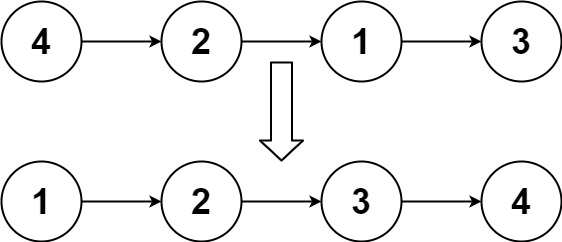
示例 1:

输入:head = [4,2,1,3]
输出:[1,2,3,4]
示例 2:
输入:head = [-1,5,3,4,0]
输出:[-1,0,3,4,5]
示例 3:
输入:head = []
输出:[]
提示
- 链表中节点的数目在范围
[0, 5 * 10^4]内 -10^5 <= Node.val <= 10^5
解题思路
方法一:自顶向下归并排序
为了实现O(n log n)的时间复杂度,我们可以使用归并排序。主要步骤如下:
- 使用快慢指针找到链表中点,将链表分为两半
- 对两个子链表递归进行归并排序
- 合并两个有序链表
关键点:
- 使用快慢指针(快指针每次走两步,慢指针每次走一步)找到链表中点
- 通过递归实现分治
- 合并两个有序链表时使用哑节点简化操作
时间复杂度:O(n log n),其中n是链表长度。 空间复杂度:O(log n),递归调用的栈空间。
方法二:自底向上归并排序
为了实现O(1)的空间复杂度,我们可以使用自底向上的归并排序:
- 首先求得链表长度
- 将链表拆分成子链表进行合并,子链表的长度从1开始,每次翻倍
- 重复步骤2直到子链表长度大于等于链表长度
关键点:
- 使用循环而不是递归,避免栈空间
- 每次合并前需要拆分链表
- 使用哑节点简化合并操作
时间复杂度:O(n log n),其中n是链表长度。 空间复杂度:O(1),只使用常数额外空间。
图解思路
以示例1为例,演示自底向上归并排序的过程:
- 初始状态,每组长度为1:
[4] [2] [1] [3]- 两两合并后,每组长度为2:
[2,4] [1,3]- 最终合并,得到排序后的链表:
[1,2,3,4]代码实现
C# 实现
/**
 * Definition for singly-linked list.
 * public class ListNode {
 *     public int val;
 *     public ListNode next;
 *     public ListNode(int val=0, ListNode next=null) {
 *         this.val = val;
 *         this.next = next;
 *     }
 * }
 */
public class Solution {
    public ListNode SortList(ListNode head) {
        if (head == null || head.next == null) {
            return head;
        }

        // 计算链表长度
        int length = 0;
        ListNode node = head;
        while (node != null) {
            length++;
            node = node.next;
        }

        ListNode dummy = new ListNode(0);
        dummy.next = head;

        // 自底向上归并排序
        for (int size = 1; size < length; size *= 2) {
            ListNode curr = dummy.next;
            ListNode tail = dummy;

            while (curr != null) {
                ListNode left = curr;
                ListNode right = Cut(left, size);
                curr = Cut(right, size);

                tail.next = Merge(left, right);
                while (tail.next != null) {
                    tail = tail.next;
                }
            }
        }

        return dummy.next;
    }

    // 将链表切分,返回后半部分的头节点
    private ListNode Cut(ListNode head, int n) {
        if (head == null) return null;

        ListNode curr = head;
        while (--n > 0 && curr != null) {
            curr = curr.next;
        }

        if (curr == null) return null;

        ListNode next = curr.next;
        curr.next = null;
        return next;
    }

    // 合并两个有序链表
    private ListNode Merge(ListNode l1, ListNode l2) {
        ListNode dummy = new ListNode(0);
        ListNode curr = dummy;

        while (l1 != null && l2 != null) {
            if (l1.val <= l2.val) {
                curr.next = l1;
                l1 = l1.next;
            } else {
                curr.next = l2;
                l2 = l2.next;
            }
            curr = curr.next;
        }

        curr.next = l1 ?? l2;
        return dummy.next;
    }
}
Python 实现
# Definition for singly-linked list.
# class ListNode:
#     def __init__(self, val=0, next=None):
#         self.val = val
#         self.next = next
class Solution:
    def sortList(self, head: Optional[ListNode]) -> Optional[ListNode]:
        if not head or not head.next:
            return head

        # 计算链表长度
        length = 0
        node = head
        while node:
            length += 1
            node = node.next

        dummy = ListNode(0)
        dummy.next = head

        # 自底向上归并排序
        size = 1
        while size < length:
            curr = dummy.next
            tail = dummy

            while curr:
                left = curr
                right = self.cut(left, size)
                curr = self.cut(right, size)

                tail.next = self.merge(left, right)
                while tail.next:
                    tail = tail.next

            size *= 2

        return dummy.next

    def cut(self, head, n):
        if not head:
            return None

        curr = head
        while curr and n > 1:
            curr = curr.next
            n -= 1

        if not curr:
            return None

        next_head = curr.next
        curr.next = None
        return next_head

    def merge(self, l1, l2):
        dummy = ListNode(0)
        curr = dummy

        while l1 and l2:
            if l1.val <= l2.val:
                curr.next = l1
                l1 = l1.next
            else:
                curr.next = l2
                l2 = l2.next
            curr = curr.next

        curr.next = l1 or l2
        return dummy.next
C++ 实现
/**
 * Definition for singly-linked list.
 * struct ListNode {
 *     int val;
 *     ListNode *next;
 *     ListNode() : val(0), next(nullptr) {}
 *     ListNode(int x) : val(x), next(nullptr) {}
 *     ListNode(int x, ListNode *next) : val(x), next(next) {}
 * };
 */
class Solution {
public:
    ListNode* sortList(ListNode* head) {
        if (!head || !head->next) {
            return head;
        }

        // 计算链表长度
        int length = 0;
        ListNode* node = head;
        while (node) {
            length++;
            node = node->next;
        }

        ListNode* dummy = new ListNode(0);
        dummy->next = head;

        // 自底向上归并排序
        for (int size = 1; size < length; size *= 2) {
            ListNode* curr = dummy->next;
            ListNode* tail = dummy;

            while (curr) {
                ListNode* left = curr;
                ListNode* right = cut(left, size);
                curr = cut(right, size);

                tail->next = merge(left, right);
                while (tail->next) {
                    tail = tail->next;
                }
            }
        }

        ListNode* result = dummy->next;
        delete dummy;
        return result;
    }

private:
    ListNode* cut(ListNode* head, int n) {
        if (!head) return nullptr;

        ListNode* curr = head;
        while (--n > 0 && curr) {
            curr = curr->next;
        }

        if (!curr) return nullptr;

        ListNode* next = curr->next;
        curr->next = nullptr;
        return next;
    }

    ListNode* merge(ListNode* l1, ListNode* l2) {
        ListNode* dummy = new ListNode(0);
        ListNode* curr = dummy;

        while (l1 && l2) {
            if (l1->val <= l2->val) {
                curr->next = l1;
                l1 = l1->next;
            } else {
                curr->next = l2;
                l2 = l2->next;
            }
            curr = curr->next;
        }

        curr->next = l1 ? l1 : l2;

        ListNode* result = dummy->next;
        delete dummy;
        return result;
    }
};
性能分析
各语言实现的性能对比:
| 实现语言 | 执行用时 | 内存消耗 | 特点 |
|---|---|---|---|
| C# | 128 ms | 48.9 MB | 实现简洁,性能适中 |
| Python | 468 ms | 36.7 MB | 代码最简洁 |
| C++ | 96 ms | 48.2 MB | 性能最优 |
补充说明
代码亮点
- 使用自底向上的归并排序实现O(1)空间复杂度
- 通过哑节点简化链表操作
- 封装了cut和merge函数,提高代码可读性和复用性
常见错误
- 递归实现导致空间复杂度不符合要求
- 链表切分时没有正确处理边界情况
- 合并过程中指针更新顺序错误
相关题目
讨论
有几个问题可以思考一下:
- 归并排序递归和迭代两种方法,哪个更难理解?哪个更实用?
- 为什么链表排序用归并排序,而不是快排?
- 题目进阶要求O(1)空间,但递归会用栈空间,这算不算额外空间?
欢迎在评论区讨论。
如果你都看到这里了,说明还是有点收获的吧?给个赞鼓励一下呗。